







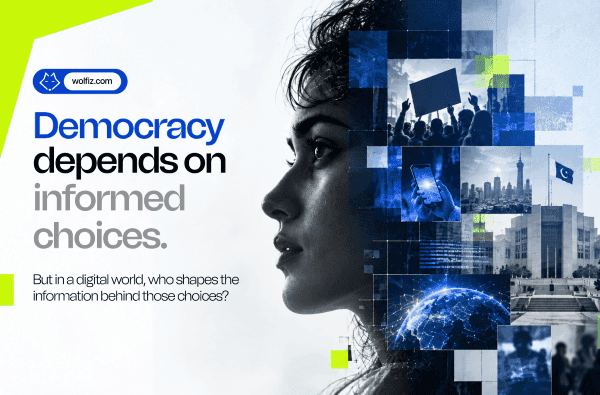
Technology was once expected to make democracy more open. Today, the harder question is whether it is also shaping the information on which democratic choices depend.
Democracy depends on more than elections. It depends on people being able to understand what is happening, hear competing views, question power and make decisions based on information they can reasonably trust. For much of modern history, that information passed through newspapers, radio, television, public institutions and professional journalism.
The internet changed that structure. In the 1990s, it was widely seen as a democratising force: decentralised, open to direct communication and capable of moving information across borders without traditional gatekeepers. People could publish, organise and connect in ways that had previously been difficult. Digital technology expanded expression, civic participation and accountability. A phone camera could document an event, a livestream could bring it to millions, and digital evidence could expose abuses that might otherwise remain unseen.
But the first digital revolution changed who could speak. Social media changed how quickly information could spread. Algorithms changed what people were likely to see. Data made influence increasingly personalised. Artificial intelligence is now changing how cheaply, quickly and convincingly information can be produced.
Social media turned the internet into an environment of constant information flow, with posts, videos, headlines, advertisements and recommendations increasingly selected by software. A platform may contain thousands of perspectives, but users experience the selection placed in front of them.
Information being available is not the same as information being visible.
Algorithms do not automatically determine what people believe, and their effects are not always straightforward. But they influence what receives attention and what people encounter repeatedly. At the same time, searches, clicks, locations and digital interactions generate data that can reveal patterns and enable increasingly personalised communication.
AI takes this further. It can generate content, adapt messages, imitate human behaviour and operate at enormous scale. Content that once required specialist skills can increasingly be created or manipulated with accessible tools. The challenge is therefore no longer simply false information. It can become industrialised influence.
AI also makes synthetic media more convincing. Audio and video have traditionally carried the weight of evidence, but realistic manipulation can make genuine material easier to dispute. The danger is not only that people believe something false; convincing fabrications can make people suspicious of genuine evidence too. If everything can be fabricated, authentic evidence can also be dismissed as fake. People may not believe the same lie, but they may stop knowing what to believe.
Yet this is not an argument against technology. The same systems that create new risks can help address them. Digital provenance can establish where content came from, authentication can help verify media, coordinated manipulation can be detected, and greater transparency around political advertising and recommendation systems can give users more context about what they are seeing.
Technology can strengthen democratic institutions too, from access to government information and public participation to election infrastructure. But resilience matters alongside digitisation. Election systems need cybersecurity, transparent data and reliable backups. A technologically advanced system is not necessarily one that digitises everything; sometimes resilience means having technology and a dependable fallback.
Technology alone, however, cannot solve an information problem. As content becomes easier to produce and distribute, people need stronger capacity to evaluate it. Digital literacy is becoming part of democratic resilience. Views do not make a claim true. A screenshot is not automatically evidence. A convincing video may still require verification, and a personalised feed may not reflect what everyone else is seeing.
This matters to voters, journalists, civil servants, businesses, teachers and policymakers. The goal is not to make everyone an AI expert, but to give people enough information literacy to question, verify and evaluate what they encounter.
There is also a deeper question: who controls the data and infrastructure through which society increasingly operates? Where data is stored matters, but so does who can access it, under what law, for what purpose and with what oversight. Digital sovereignty should mean more than where data lives; it should mean having the technical, legal and institutional capacity to protect it.
For technology companies, this creates a responsibility beyond whether a product works. A system can be technically successful while producing poor outcomes because of its incentives, data practices or design choices. Technology increasingly shapes how people communicate and access information. The question for those building these systems is therefore not only “What can we build?” but “What kind of environment will this technology create?”
The question facing digital democracy is not whether technology will shape what we know. It already does. The question is who gets to shape that process, what principles guide it, and whether people retain the ability to question what they are shown.
Because when technology shapes the information through which people make decisions, building the technology also means shaping the conditions in which those decisions are made.