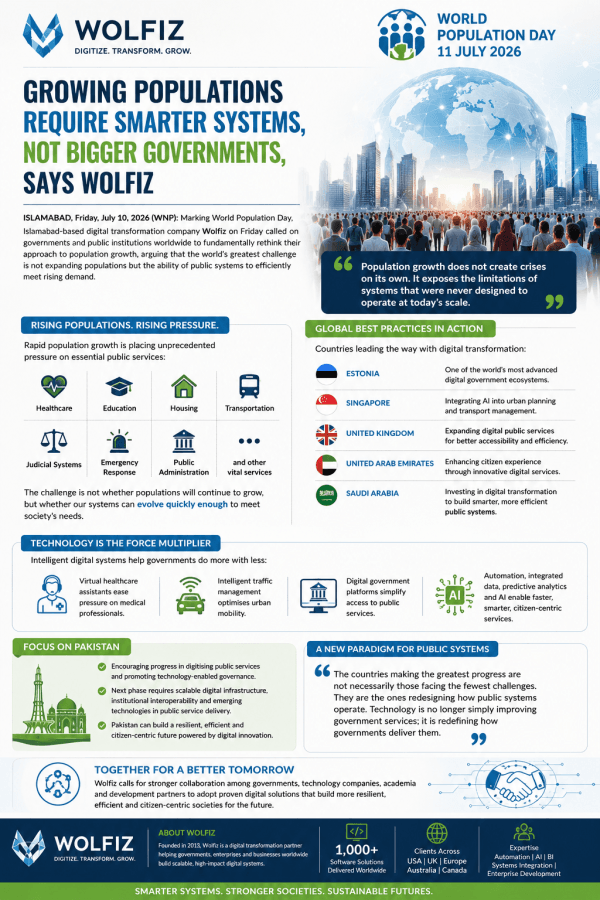
Growing populations need smarter systems, not bigger governments, says Wolfiz ISLAMABAD: Marking World Population Day, Islamabad based digital transformation company Wolfiz urged governments and institutions to rethink approaches to population growth, arguing that the world’s greatest challenge lies not in numbers but in the capacity of public systems to keep pace with rising demand.
On World Population Day, the company underscored that rising populations are exerting mounting pressure on healthcare, transportation, housing, education, judicial systems, emergency response, public administration, and other vital services. It stressed that the central question is no longer whether populations will continue to grow, but whether the systems designed to support them are evolving swiftly enough to meet the shifting needs of society. “Population growth does not create crises on its own,” Wolfiz said. “It exposes the limitations of systems that were never designed to operate at today’s scale.” Wolfiz maintained that many of the challenges commonly linked to population growth stem less from demographics than from outdated systems and governance models that have failed to evolve alongside society.
Wolfiz noted that this shift is already evident across several countries that have embraced digital transformation as a core element of public sector modernization. Estonia has established one of the world’s most advanced digital government ecosystems, Singapore continues to integrate artificial intelligence into urban planning and transport management, while the United Kingdom, the United Arab Emirates, and Saudi Arabia have expanded digital public services to improve accessibility, operational efficiency, and citizen experience. These examples demonstrate that governments are no longer required to expand bureaucracy, Instead, intelligent digital systems are enabling institutions to serve larger populations through automation, integrated data platforms, predictive analytics, and AI powered decision support. From virtual healthcare assistants that help reduce pressure on medical professionals to intelligent traffic management systems that optimise mobility and digital government platforms that simplify access to public services, technology is already transforming how nations respond to rising demand while improving efficiency and service quality.
Wolfiz said Pakistan has registered encouraging progress through initiatives to digitise public services and expand technology enabled governance. The company noted, however, that the next stage of national development hinges on accelerating the rollout of scalable digital infrastructure, strengthening interoperability among institutions, and embedding emerging technologies into the design of essential public services. “The countries making the greatest progress are not necessarily those facing the fewest challenges,” the company observed. “They are the ones redesigning how public systems operate. Technology is no longer simply improving government services, it is redefining how governments deliver them.” Wolfiz called for stronger collaboration between governments, technology companies, academia, and international development organisations to accelerate the adoption of proven digital solutions capable of building more resilient, efficient, and citizen centric societies. Founded in 2013, Wolfiz is a digital transformation partner helping governments, enterprises, and businesses build scalable, high impact digital systems.
The company has delivered more than 1,000 software solutions worldwide and specialises in automation, artificial intelligence, business intelligence, systems integration, and complex software development. With clients across the United States, the United Kingdom, Europe, Australia, and Canada, Wolfiz develops technology that enables organisations to modernise operations, improve efficiency, and build resilient digital ecosystems designed to perform today and scale for tomorrow.